Note: The events that follow occurred in June 2007, and I wrote about them later that year. This is the first time I’ve publicly shared this story. For years, I worried it would come across as critical of my mother. But now, one year after her death, I feel differently. My hope is that this story will bring some comfort (by way of shared experiences) to other adult children caring for a beloved parent with dementia. Above all, I hope you’ll appreciate the abundant humor throughout this story. Yes, caring for a parent in a slow cognitive decline is truly stressful, sad, and exhausting. But let’s be real. Just as often, it can be a real hoot.
===================================
“Look at that woman,” my mother says as we leave the retirement home dining room. She speaks loudly because she’s hard of hearing, and even without looking at the lady we’re about to pass in the hallway, I know my mother is going to say something disparaging about her. I move closer, hoping my proximity will preempt any shouting.
“I’ve never seen such big bosoms in all my life!” my mother shouts.
I glance anxiously over my shoulder, to see if the muumuu-attired woman inching along with a walker has heard my mother’s assessment of her breasts. The walked stops abruptly and the woman is slowly turning toward us, so I hurry my mother along.
“Mom, she heard you! You shouldn’t say things like that!”
“Say things like what?”
As I continue to rush her along the hallway, my mother’s attention fixes on the glass bowl of wrapped candy that sits atop the lobby reception desk, next to a bottle of hand sanitizer gel and a box of tissues. She stops. After careful examination, she unwraps a piece of chocolate and pops it into her mouth, leaving the wrapper on the counter. Reflexively, she unfastens the button on her faded pink jeans, which she has owned for over 20 years, and lifts up the bottom of her blouse, exposing a pale white stomach. “I’m getting fat,” declares the woman who weighs approximately 105 pounds.
I make note of the clock, above the reception desk. It’s only 5:45 p.m. Moop — a nickname my nieces and nephews bestowed upon my mother, whose actual name is Ruth — and I have already eaten dinner. We are to spend the entire evening together, just the two of us, at her apartment in an independent living community in Greensboro, North Carolina that my sisters and I moved her into the previous fall. Moop never goes to bed until well after dark. I wince as the realization hits me: Today is June 21st, the first day of summer.
The longest day of the year.
What are we going to do the rest of the night?, I wonder, thinking how short-sighted I was not to plan tonight’s visit. I live in San Francisco and have spent the last two weeks in Greensboro with my sisters, clearing out Moop’s two-story house, cluttered as it was with her collections of 111 Raggedy Ann dolls, rickety wooden chairs, pie birds, potato mashers, Mrs. Butterworth bottles, tractor seats, dusty children’s books, piles of unsorted bank statements, a 40-year-old bottle of Milk of Magnesia, and Pillsbury Doughboy dolls. Not just the Pillsbury Doughboy but his grandparents, siblings, and dog, too — which I helped her acquire during our many visits to antique malls and collectible shops over the years.
Having moved Moop out months ago, the house is almost entirely empty now, except for a few forlorn Paddington Bears, a chicken feeder she used as an umbrella stand, a pile of yellowed hoop skirts discovered in the attic, and a talking Captain Kangaroo doll silenced by a broken string. Just before heading over for my visit tonight, I reluctantly removed the sign Moop had hand-painted and hung on her front door — “Martha Stewart doesn’t live here” — and packed it away.
I’m exhausted from the past two weeks. No, the truth is, I’m exhausted from the past two years.
During that time, Moop began falling all too frequently in her home, catching the toaster oven on fire, setting off her security alarm at all hours, forgetting simple things, and driving ever-more dangerously. So, my sisters and I made the difficult decisions to hide her car keys and, when that wasn’t enough, to invoke healthcare power of attorney in order to have Moop declared unable to handle her own affairs. It was the only way we could move her out of her big house, an idea she resisted tirelessly, and into a safer environment in an independent living community. To avoid having to move our mother immediately into assisted living, my sisters and I hired Marcy, my eldest niece whom Moop adored, to care for Moop during the days.
During our first visit to the independent living facility, Moop was recovering from cataract surgery and ornery as ever. As the sales and marketing representative, Kathy, toured us through the facility, Moop kept her sunglasses on, her arms folded across her chest, and said nothing.
Kathy, bless her heart, did her best to enthusiastically engage Moop, by bubbling on and on about all the wonderful social opportunities Moop would enjoy.
“You can even move into an apartment that’s in a circle of other apartments,” Kathy chirped. “It’s like a small community within a bigger community!”
Met with an icy, sunglassed stare, Kathy made one last attempt to reach my mother. “Mrs. Martin,” she said, her voice rising in now-weary enthusiasm, “tell me, what would you like most in a retirement community?”
Moop wasted no time responding. “Privacy!”
As I walk with Moop down the hall to her apartment, the electric current of anxiety humming through my body borders on panic. My brain scurries desperately for a plan. Is Antiques Roadshow on tonight? Moop adores that program. The suspense of wondering how much a 50-year-old wax portrait of Siamese twins might fetch at auction will surely keep her occupied. Maybe it will even keep her dreaded Sundown Syndrome at bay.
Sundown Syndrome is a punishing side effect of dementia. As the sun begins to fall, the accumulation of the day’s confusions and overstimulation rises, causing the person with dementia to grow acutely anxious and morose. I’ve witnessed this with Moop on every one of my visits over the past few years. As the sky darkens, so do her thoughts. Why did my father have to die? Why did he keep smoking, even after his heart attack? Did she kill him with her pot roast? For years, she was convinced her overdone cooking had done in my father. Only recently has she forgotten to accuse herself of his death — one of dementia’s few blessings.
If, in the throes of Sundown Syndrome, Moop doesn’t focus on my father’s death, she dwells on her own. “I’m afraid to die,” she will say, “but I’m even more afraid of what happens after I die.” At this point, she will take a gulp of Chardonnay, which she drinks over ice in an orange juice glass, and then she will bang the glass down on her white, enamel-top table.
“When I die,” she will continue, “I don’t want to be embalmed! I can’t stand the thought of being put underground! If you put me in a casket, I’ll come back and haunt you!”
“Don’t worry Mom,” I will reply, hoping to lighten the mood. “We’re going to pop you in the oven like a pizza.”
“Huh?” she’ll say, after another gulp of wine. Moop has almost no hearing in one ear and only 50% in the other. She used to blame her hearing loss on a hairdresser, a man she claimed fried her ear drum decades ago with a handheld blow dryer. Now she’s forgotten why she can’t hear, but she refuses to wear a hearing aid.
I will repeat louder: “I said we’ll send you straight to the oven!”
She will respond with a blank look. “Good!” she will say, and then she will bang her wine glass down on the table again, like a judge’s gavel, case closed.
As we pass through the lobby, Moop asks me what killed my father. I can’t have this conversation again, so I search frantically for a familiar face, someone to help me entertain Moop — and rescue me from an endless night of Sundown Syndrome. I see no one I recognize. Just as we are about to enter the endless hallway to her apartment, I notice a familiar head of short, curly white hair: Audrey.
Audrey sits in a high-back chair in the rear of the lobby, not far from the piano. She is flipping through O: The Oprah Magazine. As always, she is dressed in a white mock turtleneck under a burgundy vest, black polyester slacks, white socks and hiking sandals with Velcro straps. Audrey is one of the few friends Moop has made so far in the community.
“Hi Audrey,” I say, overjoyed to see her. Audrey looks up and smiles warmly. I extend my hand, and I’m surprised when, instead of shaking it, she kisses it.
“It’s so good to see you again!” Audrey coos. “Where’ve you been?”
“San Francisco,” I respond. “That’s where I live.” I’ve told Audrey this several times before, but it has been months since I’d seen her.
“Hi there young lady,” Audrey says, extending her hand to my mother who, having caught sight of a mirror, is patting the back of her hair. Moop is 88 but still has her hair dyed completely blonde and cut in a pageboy. Given her slight figure and small size — she is, as the song she loves says, 5 foot 2 eyes of blue — the style suits her. She’s adorable.
 |
| Moop in her independent living apartment |
I nudge Moop gently.
“Oh, hey,” she greets Audrey. I notice a smudge of chocolate in the corner of Moop’s mouth.
As Audrey and I chat, Moop turns her head back toward the mirror. She runs her middle finger across her teeth but doesn’t notice the chocolate smear. I grab a clean tissue from my pocket and gently blot it away.
“How sweet,” Audrey notes. “I like a man who takes care of his Mama.”
Looking for a way to pull Moop into the conversation, I steer the subject to her artwork. My mother took up painting not long after I, the youngest of her five children, left for college. In the years since, she became an accomplished artist. “Would you like to see some of her paintings?” I ask Audrey.
“I’d love to,” Audrey says. Enthusiastically, she tosses Oprah aside, rises slowly with my help, and clasps my mother’s hands in hers. “I bet you’re really talented,” she adds.
Moop smiles blankly. “Well it was good to see you, too,” she responds.
“Mom, Audrey wants to see your paintings,” I explain. “I was just telling her what a wonderful painter you are.”
“Uh!” Moop explodes with disgust. “I am not!”
“I’ll be the judge of that!” Audrey says.
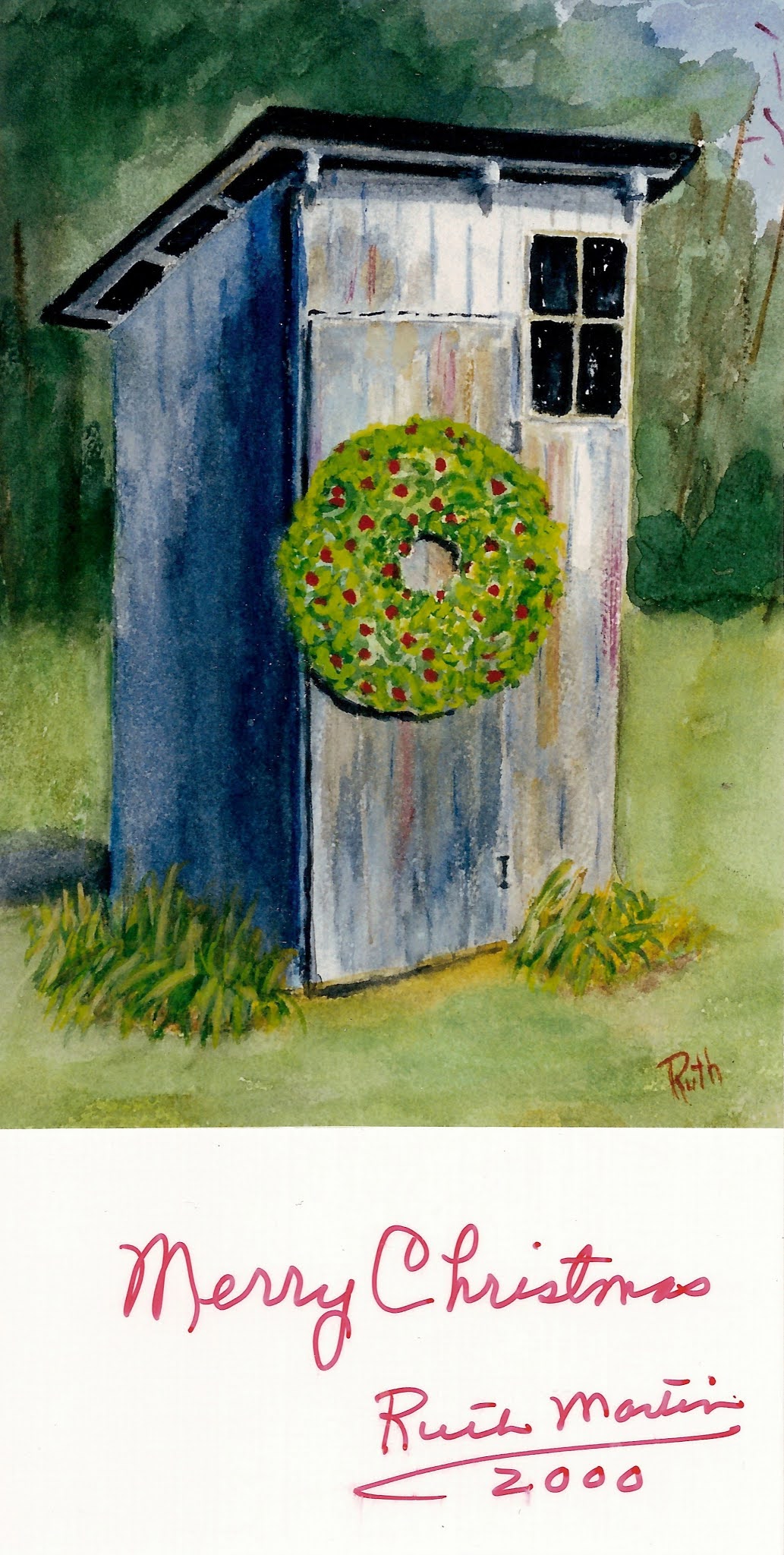
Inside Moop’s one-bedroom apartment, the next hour passes agreeably. I take framed paintings off the wall, present them for Audrey’s inspection, and provide her the back story on each one. I show her a watercolor of a weathered outhouse with a wreath on the door. “This was Moop’s Christmas card seven years ago,” I explain proudly. Audrey clucks and coos appreciatively.
“And this one?” I say, handing Audrey an impressionistic watercolor portrait of a pig. I point to the ribbon taped to the top right corner of the frame. “This won first prize in the High Point Art Guild show one year. Isn’t it fantastic?” I realize I sound like my mother did, years ago, when she used to rave to others about my cartoons.
“Oh, and let me show you the cabbage.” I scan the living room walls until I find the photo-realistic still life in oil my mother painted over 25 years ago. “This was in an art show here in Greensboro,” I continue. “Some woman stood there looking at it forever, and then she turned to Moop — not knowing she was the artist — and said, ‘What kind of mind would paint a cabbage?’”
I turn to Moop. “Remember that?,” I ask. The vacant look on her face is my answer.
Before long I’m out of Moop masterpieces to show Audrey. According to the early 20th century Co-Cola clock on the wall, it is now 7:45. (Moop calls the Coca-Cola clock her “Co-Cola clock.”) Two hours have now passed since we first encountered Audrey in the lobby. Moop has consumed six orange juice glasses of wine, which is a lot for a small woman but isn’t quite as much as it sounds, as Marcy had recently started pouring out half the wine in each bottle and refilling them with water.
 |
| Moop’s apartment, 2007. Note the ‘Co-Cola’ clock |
“How long have you lived here?” Moop asks Audrey.
“About three years,” she answers. “I’m from Boston, originally. Grew up on Ruggles Street, about two miles from Fenway Park.”
Moments later, Moop turns to Audrey. “How long have you lived here?”
“About three years,” Audrey answers, as if for the first time. “I grew up on Ruggles Street in Boston, near Fenway Park.”
The pendulum on the Co-Cola clock swings left, right, left, right. I ask Audrey what her family was like; anything to move the conversation forward, instead of in circles. Moop shoots me an exasperated look and nods blatantly toward Audrey, as if to say: Get rid of her!
“My father ran a little corner store on Ruggles Street,” Audrey says. She leans forward in her seat, eagerly, and adjusts her large white-framed eyeglasses. “He always had the freshest produce! Oh, it was a big day when he received a shipment of pineapples. A big day. Sweetest pineapples you ever tasted!”
Moop bangs her wine glass down on the enamel-top table and rolls her eyes at me with all the subtlety of a silent film star. So far Audrey is oblivious to Moop’s growing agitation, but her oblivion can’t last forever. I decide I must find a polite way to get Audrey to leave — if for no other reason than to spare her feelings. Perhaps in the process, I can make my own exit, too. The exhaustion of the past two weeks is suddenly overwhelming me.
“May I have a glass of water, please?” Audrey asks.
This is not what I’d hoped to hear but I smile bravely. “Sure,” I say, and head to the kitchen.
Moop turns to Audrey and says wearily, “How long have you lived here?”
“About three years,” Audrey replies quietly.
Moop follows me into the kitchen. “When is she ever going to leave?” she demands, with no effort to lower her voice. “Can’t you make her leave?”
“Ssshhh!” I hiss. “Go sit down, I’ll think of something!”
As Moop exits the kitchen with a loud huff, I manage to find a glass that’s even smaller than an orange juice glass — it’s more like a large shot glass. I fill it halfway with water in hopes of discouraging Audrey from lingering longer than necessary. And, what the hell, I load up a wine glass full of watered-down Chardonnay and kick back a few gulps to calm my last-good nerve. Returning to the living room, I hand Audrey her water glass. Moop shoots me another look, more exasperated than the last. This time I’m certain Audrey sees the extravagant eye roll.
Minutes later, with the conversation stalled, I turn to Audrey and say, “You know, Moop is a bit tired. I’ve had her out all day.”
Audrey adjusts her glasses. “Oh, I’ll bet she is,” she says understandingly. She places one hand on her purse, which sits on the floor next to her chair. I let out a little sigh of relief.
“Oh heavens no! I’m fine!” Moop says, with a dismissive wave of her hand. Audrey smiles, releases her purse strap, settles contentedly back into her chair.
“How long have you lived here?” my mother asks.
Oh. My. God. I want to scream, “She’s lived here three years — and any minute now it will be four years!”
“I wonder if Antiques Roadshow is on?” I try to say calmly, hoping to conceal my angst. I flip through the TV channels but find nothing on except news, Baywatch, infomercials, a gospel program, another gospel program, and an episode of Animal Planet in which a Komodo dragon is closing in on a rooster.
I continue to fumble for an exit strategy. “Is it warm in here to y’all?” I ask, tugging at my shirt. Maybe I can convince them to continue this excruciatingly endless loop of conversation in the air-conditioned lobby instead of my mother’s stifling apartment, at which point I can claim excuse myself.
“I’m right comfortable,” Moop says, polishing off another glass of watery wine.
“Me too,” says Audrey, which prompts Moop to roll her eyes again. The Co-Cola clock says “tick tick tick.”
All I can think of is that the day after tomorrow, I fly home to San Francisco. Home. I miss Nick. I miss our city. I miss my life. I want my life back! It’s ironic, I think; growing up in Greensboro, I dreamed of traveling to great cities like San Francisco. Now I live in San Francisco, and for the past several years, nearly every time I travel, it’s to Greensboro.
“May I use the little girl’s room?” Audrey asks. Moop nods and points disinterestedly toward the bathroom door, which is not far from the door that leads into the hallway.
The second Audrey retreats into the bathroom, Moop leaps out of her chair. “Who is that woman?” she asks, fists clenched, shoulders raised. “Why won’t she leave?”
“Mom, lower your voice! She’ll hear you!”
“I don’t care! Who is she?”
“It’s Audrey! You eat with her in the dining room practically every day! And lower your voice!”
“How will we ever get rid of her?” Moop asks, shaking her fists.
“Just tell her you’re tired!”
“Set the timer? What for? That won’t get rid of her!”
“Let me handle it!” I say.
“Huh?”
“I said ‘let me handle it!’ Just relax!”
Five minutes pass. Ten minutes.
Mom is pacing now. “What the hell is she doing? She must be having a ball in there!”
“Mom, please relax!”
Fifteen minutes have now ticked by. What the hell is Audrey doing in there? Has she forgotten why she’s in the bathroom, or where she is? Is she ill? Dead?
“Well, I’m going to get some Raid and spray it under the door!” Moop threatens. She’s on her way to the kitchen; I quickly follow. She starts opening cabinet doors, hunting for insect repellent..
“Mom, stop it!”
Moop has flung open nearly every cabinet and is now focusing on the pantry where her can of Raid lives; I saw it earlier, mixed in with her spices. I move to block her when Moop snaps: “Damn it! What was I looking for?”
I throw up my hands in complete exasperation. I’ve got to get out of here! I’ve put up with a lot in the last two weeks. I’ve boxed up Raggedy Ann dolls until I see button eyes looking at me everywhere I go. My sisters and I spent days cleaning out the moldy basement and probably inhaled Asbestos dust in the process. I’ve wiped spider webs off my face and out of my hair. I’ve bubble-wrapped two dozen Mrs. Butterworth bottles and have no idea why I did such a thing. I’ve gathered all the old rusty paint cans in the garage and when I turned one over I was greeted by a half-eaten mouse and I screamed and stepped back so suddenly that I hurt my ankle and…and…and I’m done! I’m leaving! But how?
The toilet flushes, followed by the sound of running water. I glance over at Audrey’s purse on the floor, at my mother moving toward to the pantry. I spring into action, steering Moop back to the living room. I tell her not to say anything. I bend down, scoop up Audrey’s purse, and hurry toward the bathroom.
The bathroom door opens. Audrey slowly emerges. She sees me and smiles sweetly.
“Moop is really tired and needs to go to bed now, but she’s too polite to admit it to you,” I say, as calmly as I can. “But thank you so much for your visit. It was great to see you!” I hug Audrey warmly, hand her her purse, open the door and gently guide her into the hallway. “Bye bye, sweetheart.”
Befuddled, Audrey turns to blow me a kiss. I return the affection and quickly close the door, careful not to slam it.
“Who was that damn woman?” Moop wonders. “Point her out to me tomorrow! I don’t ever want to get stuck with her again!”
“Mom, Audrey is sweet. She just stayed too long, that’s all.”
“Well, from now on I’m going to avoid her like the plague!”
A few minutes later, I say I have to go, citing fatigue. “Why are you tired, honey? It’s only 9:00,” Moop asks. “The night’s young.”
The next morning, when I awake, it’s nearly 11 o’clock. I shower slowly, under the hottest water I can stand. I wonder if I’ll be able to speak coherently today. I don’t want to go back to my mother’s apartment. But it’s my last day before I fly home. I won’t be back for at least three months. I must go.
Around noon, I enter the lobby and stop midway, as if I’d just seen a deer and didn’t want to startle it. A few feet away, there’s Moop, in the same outfit she wore yesterday — pink denim pants, long-sleeve white turtleneck. She’s standing beside Audrey, who’s also in the same clothes she wore yesterday. They’re reading the bulletin board’s announcement of that day’s events.
And they’re holding hands.
I walk up and put my arms around them both. “Ladies,” I say, “shall we have some lunch? I’m starving!” Moop hugs me warmly, and so does Audrey. As we move toward the dining room, Moop and Audrey are still holding hands, and I’m surprised to find myself feeling a twinge of regret that tomorrow, I’ll be going home.