Showing posts with label Southern Culture. Show all posts

Wednesday, January 9, 2013

Southern Storytelling - The Preacher and The Cigarette

The setting is Margie's Diner, a reliably greasy eatery in the small industrial city of Roanoke Rapids, N.C., in the early 1980s. It's a workday afternoon, and Adrienne Ivey, a lifetime resident of the city and the local newspaper's top reporter, sits in an upholstered booth. She sprinkles salt on her chef's salad, takes a deep drag off her cigarette, spots "The Preacher," and sighs. "Here we go," she thinks.

The lanky man lumbering toward Adrienne isn't an ordained preacher. The Preacher is simply his nickname, one he wears proudly like a new Stetson hat. He earned the nickname because he's apt to preach. He tells you exactly what he thinks whether you asked for his opinion or not, and usually, you didn't ask.

"Afternoon, Adrienne," says The Preacher, towering over her. He glances at the empty seat across from her and then back to Adrienne, with all the subtlety of a silent film actor.
Adrienne Ivey at her desk
"Be my guest," Adrienne replies, knowing she has no other alternative but to be rude. As The Preacher takes his seat, Adrienne alternates between bites of her salad and deep draws from her cigarette. The Preacher's nose twitches. Small talk is exchanged; who's been at church lately, who hasn't, that sort of thing.

Adrienne exhales more smoke, this time a bit closer to The Preacher's nostrils, which flare with indignation at each of Adrienne's exhalations. The Preacher tries to ignore the smoke and continues with the small talk, which consists primarily of his opinions about who's up to no good.

Finally, Adrienne lets out a stream of smoke like something you'd see from a rocket ship blasting off. "Adrienne," The Preacher says, his voice lowering, "I'd rather commit adultery than smoke a cigarette!"

Adrienne narrows her eyes, looks squarely at The Preacher, and says, "So would I, Preacher. But I've only got 30 minutes for lunch."

--

My previous post about Southern storytellers brought Adrienne, and this story, to mind. Next time: Adrienne catches me in a 'white lie' during my first week on the job--and saves me from a dreadful fate.

Saturday, January 5, 2013

Are Southerners Natural-Born Storytellers?

"Southerners love a good tale. They are born reciters, great memory retainers, diary keepers, letter exchangers...great talkers."

Eudora Welty
The above quotation comes from a woman who epitomized Southern storytelling to generations of readers, Eudora Welty. The Mississippi writer's quote evokes images of Southern folk in creaky rocking chairs on weathered front porches, drinking bourbon out of Mason jars, swapping stories late into the night, to an hour when even the crickets and 'lightning bugs' (aka fireflies) have retired.

But was Welty right? Are Southerners inherently good at spinning a compelling yarn? Or is it a myth, perpetuated by the enduring reputations of Southern writers (Welty, William Faulkner, Margaret Mitchell, Truman Capote, Harper Lee, Flannery O'Connor and such)? And if it was true in Welty's time (1909 to 2001), is is still true today in the age of Facebook, Twitter, and text messaging?

Truman Capote
I think there is some reality to Welty's quote, but there's also some wishful thinking behind it--which, come to think of it, are frequently the ingredients for a good Southern story.

It's true that Southerners tend to be 'great talkers,' but that's not the same as being a great storyteller. Ask the typical Southerner a question about, say, a favorite food, and he or she is likely to tell you the entire recipe or the name of the restaurant that serves the particular dish plus directions for how to get there--all without a pause.
Flannery O'Connor

One of my closest Southern friends has this habit, especially when talking about someone else (something we Southerners love to do). He'll start off with an interesting piece of information but soon gets bogged down in irrelevant details. When I see this happening, I try to stop him by saying "Mother's maiden name!" This is code between us that means: Stop before you tell me everything I don't need to know about this person including her mother's maiden name!

I've known some fascinating Southern storytellers, but they're usually not great conversationalists. Recently, I ran into a man I knew years ago when I lived in Charleston. He was seated at a table in a San Francisco cafe. Once I said his name and he recognized me, his one-man show began. What followed were a string of hilarious, witty, and at times poignant stories. But not once did he ask how I was doing, as I had a few stories of my own to share. When I tried to tell him, he changed the subject back to himself. Narcissists, whether of Southern, Yankee, Midwestern, or Japanese extraction, are often fascinating but ultimately tiresome people.

Southerners, in general, often have a heightened sense of drama and frequently possess a terrific sense of humor, especially about themselves, which helps a lot when telling a good story. The Southerner's slower sense of pacing also contributes, as does the accent. Some Southerners are keenly aware of their region's reputation for good storytelling and feel a duty to preserve it, as well. There's even an organization called the Southern Order of Storytellers, based in Atlanta, whose mission is "to bring storytelling to wider audiences and help make storytelling once again an integral part of culture and entertainment."

Finally, there are lots of eccentrics in the South--people who know they are outside the mainstream. Rather than denying it, they flaunt it; eccentricity is their calling card. These are the characters who tell the richest stories, or who are the basis of stories others tell about them.

In other words, a Southerner isn't by nature a great storyteller, but the South has its fair share of them. But for how long? The Internet, globalization, and other forces are flattening out regional and cultural differences, so it's only a matter of time before Southern storytelling becomes yet another lost art form.

In the meantime, however, we have Leslie Jordan.

Jordan is a gifted actor from Tennessee best known for his roles in Will and Grace and Sordid Lives, the film and the TV series. During a recent one-man show in San Francisco, Jordan held his audience in rapt attention for two hours as he spun one Southern story after another, many of them featuring eccentric characters (himself included). If Southern storytelling is a dying art form, Jordan is single-handedly keeping it alive. I'll conclude with two examples.

Leslie Jordan
An anecdote Jordan re-enacted on stage was about how, as a boy, he would hang out in the local beauty parlor with his mother. One day, in walked the town tramp, her torpedo tits "entering before she did." Jordan's recounting of this story was full of small details, from the clothes the woman wore to the cigarettes she smoked. At one point, the hair stylist asked the town trollop if she wanted her hair teased. "Teased?," the woman responded. "I want it terrorized!"

In another anecdote, Jordan recounted a chance meeting with a Southern drag queen who called herself Kitty Litter. Jordan had been friends with Kitty in Atlanta years ago, in their wilder days. During their unexpected encounter years later, Kitty asked Jordan if he still drank; Jordan said he stopped long ago. "Me too," said Kitty. "I only have a little Peppermint Schnapps now and then to sweeten my breath."

And then, after a beat, Kitty added, "Sometimes, my breath is so sweet, I can hardly stand up."

----- What do you think? Are Southerners great storytellers? Do you have a great 'Southern' story to share? Let me know in the comments below.

Sunday, December 30, 2012

New Year's Resolutions for Southerners and San Franciscans

Time to make New Year's Resolutions. Even though most resolutions have the life span of a butterfly with a bad cough, it never hurts to pause, reflect, and vow to be a better person in the coming year.

In the spirit of the season, the following are New Year's Resolutions from imaginary Southerners and San Franciscans--two demographics I admire, love, consider myself a member of, and, yes, enjoy poking fun at. I've also added some vintage New Year's Eve photos I found online, just for the heck of it.

Weight

The Southerner: "I want to see my shoes again while standing up. Mostly to make sure they're not white and it's after Labor Day."

The San Franciscan: "My goal is to keep my weight down and my Klout score up."


Getting Organized

The Southerner: "I resolve to stop storing my pistol in my makeup drawer."

The San Franciscan: "I will remember that after drinking my Starbucks non-fat-one-Splenda-extra-foamy-double-tall latte, I will put the used cup, brown paper 'sleeve,' and wooden stir stick into the composting bin. The plastic lid goes in recycling. And those bottles of 'ethical' plastic water bottles I bought go into my messenger bag so I won't have to pay the 10 cent paper bag fee."


Budget

The Southerner: "Start putting pocket change into my Piggly Wiggly piggy bank. Those summer shag dancing competitions in Myrtle Beach don't come cheap!"

The San Franciscan: "I resolve to not blow my budget this year for medical marijuana lollipops and leather chaps for the Folsom Street Fair, and to add money to my budget to offset my carbon footprint whenever I drive my Prius to Whole Foods."


Giving Back

The Southerner: "It's time for me to give back all those casserole dishes my cousins brought to my house for MeeMaw's 105th birthday party."

The San Franciscan: "I will stop hogging the electrical vehicle charging station in the Noe Valley Walgreen's parking lot."


Career

The Southerner: "I resolve to leave my job as a banker in Charlotte for something totally different--like being a banker in Atlanta."

The San Franciscan: "It's time I left my exhausting job at Google and got an exhausting job at Facebook. Besides, Facebook's chef is, like, way better than Google's."


Your Resolutions?

Whether you're a Southerner, a San Franciscan, or something entirely different, what are your New Year's resolutions? Serious or silly, I'd love to hear them.

Thursday, December 13, 2012

Sh%t Southern Women Say

"Some fool stole my buggy at the Piggly Wiggly!"

"Dern! My tannin' bed's broke!"

"He's dumb as dirt, bless his heart."

"Does this pistol come in pink?"

"I'm fixin' to beat your ass!"

Admittedly, I've never heard a Southern woman say any of the above. But they do in the hilarious YouTube video, "Sh%it Southern Women Say Part 1." I've posted both of the "Sh%t Southern Women Say" clips below because, as a Southern woman (or man) would say, they're a "hoot." And I'm adding a few things I've heard Southern women say that aren't in either of these videos: 

"I hate I heard that," the meaning of which is obvious. 

"I hate I drank that," which means: "Damn this is so good, I'm gonna get addicted." 

"I hate I ate that." Same as "I hate I drank that."

"I'm sorry but I'm sorry." 

"She doesn't have the sense God gave a flea."

"Do I have on too much makeup?" (Usually asked by someone whose makeup was applied by Bozo the Clown. In the dark.)

"What time should I come to y'all's house?"


Thursday, October 11, 2012

Does Honey Boo Boo Get Spanked in School?

Recently, I turned on CNN to see what in the world was happening. I expected news about the presidential election, the economy, and other such weighty matters. Instead, I learned about Honey Boo and school paddling.

I'd heard of Honey Boo Boo, of course. She's the child beauty pageant contestant in Georgia who, along with her family, is the focus of the reality-TV show Here Comes Honey Boo Boo. The CNN segment was about the show's huge ratings success and the fact that the titular star is now a household name. This fact was confirmed for me personally when, a few days later, a Southern friend jokingly used 'Honey Boo Boo' as a term of endearment for me.

Next up on CNN was a segment about school paddling. The news hook was that a male teacher in Texas had paddled a teenage girl student (which, no matter where you are on the corporal punishment issue, just feels horribly wrong). CNN flashed a map of states in which school paddling was allowed. Guess what? Except for Virginia, every state in the South allows school paddling.

Honey Boo Boo: Naughty or nice?
Wait a minute, I thought: Honey Boo Boo is a child who, presumably, attends school. She lives in Georgia. I wonder if any teachers have paddled Honey Boo Boo? Was she naughty enough to provoke such treatment?

I became infinitely curious about the child dubbed by at least one blogger as "the redneck Shirley Temple." So I TiVo-ed her show, starting with a rerun of the first episode. A night or two later, Nick and I sat down to watch. We started midway through the pilot episode because of a TiVo recording 'boo boo.'
Shirley Temple, left. The death of taste and decency, right.

Our first image was of a bunch of people gathered around a large, red mud hole. Each person took turns getting hosed off before jumping into the hole. Nick and I looked at each other. "Turn it off," Nick said. "Done," I replied, hitting the 'off' button.

The show most definitely appalled but failed to enthrall. It's not that I have a problem with people jumping into mud holes to cool off; they're not harming anyone except perhaps themselves (that mud hole looked shallow). I turned off the show because it made me feel awful, as if I'd just unintentionally insulted a child.

Like many reality TV shows, Honey Boo Boo encourages its viewers to feel superior to other people and laugh at them. I was certainly guilty of such behavior in the past, and I'm not immune to it now. It's practically engrained in our culture. But that doesn't mean it makes me feel good about myself (it doesn't), or that it's something I'll actively devote time to it (it's not). Rather than help me unwind after a hard day of work, a show like Honey Boo Boo makes me agitated and uncomfortable. Perhaps a better name for the show would be American Horror Story: The South.

Based on my brief viewing of her show, I have no idea if Honey Boo Boo is naughty enough to make teachers want to spank her. But I do know this: The producers of Honey Boo Boo could use a little paddling.

Saturday, February 25, 2012

"The Help," The Oscars & Movies Set in the South

On Oscar night, I doubt The Help will win Best Picture. It was a page-turner of a book and, all told, a pretty good movie, one I'm sure I'll watch again at some point. For whatever reason, though, it's not among my most favorite movies set in the South.

If there were an Oscar for Best Southern Picture of All Time, I'd nominate the following:

* A Streetcar Named Desire (1951) Tennessee Williams (playwright) and Elia Kazan (director) were a combustible combination on Broadway, and this film (set in the French Quarter of New Orleans) captures their powerful collaboration at its best. Although this famous play's subject matter was slightly white-washed to suit Hollywood censors, there's no denying the sweaty, claustrophobic, jazzy, sexy, raw-nerves aura of this movie. Sixty years later, Marlon Brando is still magnetic (and mega hunky, even by today's standards). Vivien Leigh is a bit campy at times ("Stella, run out and get me a lemon Coke with chipped ice"). But oh man, that final scene? I can see it anytime in my head without having to watch the movie. If you love this movie, read When Blanche Met Brando, a fascinating behind-the-scenes look at the making of the play and film. 

* Big Fish (2003) One of my favorite Tim Burton movies, it's an ode to Southern Gothic storytelling--which is usually long on entertainment value and imagery and mostly devoid of actual facts. The large cast includes Albert Finney, Ewan McGregor, and Jessica Lange, all at their best. Warning: The final moments pack an emotional wallop. 

* Loggerheads (2005) A little-known gem I caught at a San Francisco film festival, Loggerheads tells three different but interlocking stories, all set in North Carolina. Tess Harper, Bonnie Hunt, and Michael Learned are among the strong cast. The stories involve a young gay man who loves loggerhead turtles and his adoptive and birth mothers. I'd tell you more, but I think this movie is best experienced without a lot of upfront explanation and backstory. 

* Junebug (2005) This independent feature filmed in North Carolina gets the local atmosphere and accents right--there's even a mention of Cheerwine, as I recall. Plus it co-stars a charming Amy Adams in her breakout role. 
* Body Heat (1981) This is the kind of sexy film noir thriller Hollywood would have made in the 1940s had it not been for all that tedious, Hays Office/studio censorship. Set in Florida during a heat wave, this movie isn't particularly Southern in flavor (other than all the sweat). But it's a hugely entertaining showcase for Kathleen Turner as the ultimate femme fatale and William Hurt as her not-so-bright man toy.

* The Little Foxes (1941). No one did evil better than Bette Davis, and she was rarely better than when she was directed by William Wyler, who directed this film adaptation of the Lillian Hellman Deep South melodrama of greed. If nothing else, this movie is a showcase for black-and-white "deep focus" cinematography. Need an example? Watch the scene in which Bette, in the foreground, waits expectantly as her dying husband, in the background, crawls up the steps to retrieve the vital medication she has cruelly denied him. Both the foreground and background subjects are in clear focus--something you just don't see in color films. Gregg Toland, the cinematographer, also did the camera work for a little movie you may have heard of called Citizen Kane. BTW, as much as I love Bette Davis in the role, Tallulah Bankhead originated the part on stage and was said to be a sensation. Would she have overpowered the screen? Maybe. I'd still like to have seen her do the role. 

And the Oscar goes to: A Streetcar Named Desire. It's still a knockout of a movie.

Others that could have been contenders (to paraphrase Marlon Brando): 


* Fried Green Tomatoes (1991). I didn't add this to the main list because a) it's such an obvious candidate and b) it's rather schmaltzy and sentimental. Even so, it's funny, touching, and absorbing. It stars Jessica Tandy, always a treat to watch and Kathy Bates, in one of her first great performances ("I'm older and have more insurance!").

* Steel Magnolias (1989) Sally Field in the cemetery scene is reason enough to watch. 

* Norma Rae (1979) Once again, I loved Sally Field, especially when she stood on top of a table holding that "Union" sign. She had some great lines, too. When Rob Leibman, as a Yankee unionizer, trips and falls onto a cow pie and is all undone, Sally just sighs and says reassuringly: "It's only grass and water."

Others I used to love but frankly, my dear, I'm kinda tired of: 

* To Kill a Mockingbird (1962) I know, this is practically everyone's favorite Southern movie. I loved it as a kid and for many years after. And I still find it admirable and nicely acted. But here's a little secret: The book is even better. And if you think you don't need to read it because you've seen the movie 12,000 times, think again.

* Gone With the Wind (1939) I'm sure if someone sat me down in a movie theater and this movie began to unspool, I'd find it difficult to leave. But left to my own devices, I'm not ready to devote another four hours of my life to this film anytime soon. Then again, I can't resist Mammy, especially when she accuses Scarlett for waiting for Ashley Wilkes "just like a spid-ah."

Which movies would you nominate for Best Southern Picture of All Time, and why? I'd love to know. 

Sunday, January 29, 2012

Is Southern Hospitality a Myth?


I hadn’t seen my friend Scott for several months. As we were catching up, I asked if he and his family had been on any interesting trips lately. He mentioned they had rented a beach house outside Charleston last summer; it was their first time there. A native New Yorker now living in San Francisco, Scott said he had barely spent any time before “down South.”
Then he asked, “Do you believe there’s such a thing as Southern hospitality?
Being Southern, I thought it hospitable to encourage him to continue before offering my opinion. “Do you?” I asked.
“I think it’s a myth,” Scott answered. He explained that the owner of their rented beach house had misrepresented its amenities and wouldn’t fix a major problem Scott had called to complain about. He said the wait staff in several restaurants they’d been to in Charleston had been indifferent and unaccommodating.
“So I don’t buy this Southern hospitality thing at all,” Scott concluded.
Feeling defensive, I explained that Charleston, being a hugely popular tourist destination, has a lot of people living there now from outside the South. (A poor excuse, admittedly.) Also, Scott and his family had gone to a top tourist destination toward the end of the tourist season. By that point, no doubt every restaurant server’s last good nerve had been plucked more times than a banjo string at a bluegrass convention.
And yet, Scott’s question left me wondering: Are Southerners truly more hospitable than people in other areas?
Yes Ma'am
At a minimum, I believe most Southerners are polite. They still say “yes sir” and “yes ma’am” and “thank you” and “you’re welcome.” They will hold the door open for you, regardless of your sex. And Southerners are generally friendly. When you’re out for a walk in a residential neighborhood, a Southern stranger will say hello to you, even wave from across the street.
True hospitality, to me, is something much more than politeness and friendliness. It’s a willingness to take action out of compassionate regard for the needs of others, even when they’re strangers and it’s of no real benefit to you. I’ve certainly seen this in the South—and many other places as well.
No Worries, Mate
On a 1996 visit to Melbourne, Australia, Nick and I became completely lost, so I ventured into a corner market to ask for directions. After waiting my turn in line, I asked the young woman behind the counter how to get back to our hotel. She gave me convoluted directions I had trouble grasping.
I was aware there were three people in line behind me. Not wanting to keep them waiting, I thanked the friendly clerk and started to leave. To my astonishment, she insisted on walking outside with me so she could point out the way. She left the cash register unattended, not to mention those three people waiting in line. Once she had set me straight (so to speak), I stuck my head into the store. The three people in line smiled at me, and I thanked them for their patience. “No worries, mate,” one of them responded, and they all wished us luck.
In London two years ago, I was leaving the theater with a group of people. We became confused as to how to take the tube back to our hotel. A young woman overheard us, said she was going in that direction, and invited us to follow her. She sat with us on the train and stayed past her own stop, to ensure we departed at the correct station.
Losing it in Times Square
And then there was my first trip to New York, way back in 1979. Toward the end of my visit, I discovered, to my horror, that I had lost my wallet—in Times Square. Fortunately I was with a group of college friends and I rode back to North Carolina with them. I figured my wallet, along with the money in it, was lost forever. (I didn’t have a credit card at that point.)
A day after my return, I received a collect phone call from someone in the New York City area. The caller had found my wallet. He offered to mail it to me but wanted permission to deduct the shipping cost from the bills in my wallet. A few days later, my wallet arrived intact, with all my money minus the postage costs.
And so, hospitality exists everywhere—even in Times Square. It’s by no means indigenous to the South. On the other hand, jerks are everywhere, too. You get into trouble trying to generalize about any group of people, whether it's where they live or how they live.

Even so, I feel the need to defend the notion of Southern hospitality and to do my meager part to ensure its survival.
In San Francisco, when I see tourists confused as to which way to go, I will sometimes stop and offer directions. When I notice a tourist taking a picture of his friends, I’ll often ask if they’d like me to take the picture. Partly, my motivation is for them to go home and say “Those San Franciscans are very friendly.” But at the end of each encounter, I always say in my best drawl, “Y’all have a nice day."
==
What do you think? Do you believe Southerners are more hospitable than other people? What's been your experience with a stranger being truly hospitable to you in your travels?

Wednesday, January 18, 2012

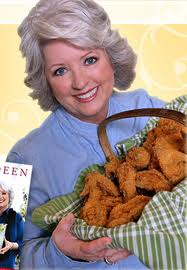
Paula Deen, Diabetes, and Deep-Fried Lasagna

Paula Deen is probably feeling a bit fried right now, and it's not because she's busy making deep-fried lasagna.

The Savannah, Georgia cooking show host just revealed she has Type 2 diabetes. Apparently, Ms. Dean has known this for three years while she continued to share such diabetes-unfriendly recipes as fried bacon mashed potatoes, fried peanut butter and banana sandwich, and fried tortellini with marina cream sauce.

Truthfully, I haven't paid much attention to Ms. Deen until now. Yes, she's a Southern TV personality, which you'd think would make her of interest to me; but then again, so is Nancy Grace. Also, I'm a bit tired of all these cooking celebrities. But I was sorry to hear about her diabetes, and now that she's in the news, I decided to read up a little on her. I discovered some fascinating facts in her bio.

* Paula got her start with a small catering company called The Bag Lady. She'd make sandwiches and other meals, which her sons delivered. Among the tasty sandwiches she offered were fried bologna, fried duck liver, and fried pig's feet. Each meal came with a free serving of fried iced tea.

* Paula was once held at gunpoint during a bank robbery and forced to act as an accomplice. In order to help the robber conceal the stolen cash, she made him a fried money sandwich.

* After the bank robbery, she became agoraphobic. Because she was afraid to go out, she could no longer make her daily trips to the nearby Kentucky Fried Chicken. (She was such a regular at her local KFC that she had her own PO box in the kitchen. A mattress store once tried to deliver her new mattress there by mistake.)

* Paula self-published her first cookbook, which she sold in her Savannah restaurant. A literary agent, dashing into the restaurant to escape a thunderstorm, noticed the book and was impressed. After eating Paula's signature three-course meal--fried chicken pot pie, fried Caesar salad, and fried chocolate cake--the agent knew a new cookbook sensation was born. (Unfortunately, the agent died a day later.)

* Paula had a bit part in a movie, Elizabethtown, with Orlando Bloom. She played a fried egg sandwich.

* Paula is married to a tugboat captain. He's in charge of ensuring that the Crisco container ship makes its way safely to their home every day.

Okay, that's enough fun and games for now. I've got some deep-friend lasagna to make.

Friday, December 9, 2011

Just in Time for the Holidays - The Funniest Southern Novel Ever Written

If you've never read A Confederacy of Dunces, then please take a second and read the following excerpt. It may help you make up your mind whether you want to read what I absolutely believe is the funniest novel ever set in the South, if not the funniest novel ever written.

"Ignatius pulled his flannel nightshirt up and looked at his bloated stomach. He often bloated while lying in bed in the morning contemplating the unfortunate turn that events had taken since the Reformation. Doris Day and Greyhound Scenicruisers, whenever they came to mind, created an even more rapid expansion of his central region. But since the attempted arrest and the accident, he had been bloating for almost no reason at all, his pyloric valve snapping shut indiscriminately and filling his stomach with trapped gas, gas which had character and being and resented its confinement. He wondered whether his pyloric valve might be trying, Cassandralike, to tell him something."

That excerpt is just one of countless other parts of the book that made me laugh out loud as I read them, hungrily underline them with a yellow marker, and come back to re-read them again over the years.

The Ignatius mentioned in the excerpt is Ignatius J. Reilly, the book's protagonist, a wildly delusional French Quarter nut case who wanders the streets in a green hunting cap. His "full, pursed lips protruded beneath the bushy black moustache and, at their corners, sank into little folds filled with disapproval and potato chip crumbs."

While Ignatius is the main character of A Confederacy of Dunces, his pyloric value plays at least a supporting role during their many French Quarter misadventures together. Yes, it's that kind of book.

The novel is priceless to me for so many reasons. It paints a vivid picture of New Orleans in the early 1960s, with actual stores and locations (some of them long gone but fondly remembered) woven into the narrative. (There's even a statue of Ignatius in New Orleans now.) The rogue's gallery of quirky characters is as rich as any you'll find in a novel. The author's writing style perfectly complements Ignatius' outrageous delusions of grandeur. This novel truly deserved the 1980 Pulitzer Prize it won for fiction.

But not all of Dunces is a laugh-out-loud experience. The backstory of how this book came to be published is tragic. The author, John Kennedy Toole, frustrated by so many rejections over so many years, committed suicide.  His mother took up the cause to get the book published and eventually brought it to the attention of noted author Walker Percy. He saw in the book what so many others hadn't: that Confederacy of Dunces is a rare novel of brilliance, humor, and surprising depths of sadness. Similarly, efforts to make a film of Ignatius' exploits have stopped and started over the years, with everyone from John Belushi to Will Farrell being considered for the role. As far as I know now, there is still no definite plan to make a movie of Dunces.

When I first read the book, I was about 23 or 24. I didn't dare read it in public because I never knew when I would erupt into volcanic laughter--a reading experience I have never had before or since.

And at that age, I didn't see the despair and melancholy just beneath the surface of the novel, either.

Rereading the book nearly 30 years later, that sadness is now on the surface for me. What's changed between my first and most recent readings? Not the book, certainly. I'm the one who's changed. I've been around long enough to recognize despair, isolation, insecurity, and misdirected rage when I see them, emotions that were too often invisible to me in my early 20s.

If you love Southern literature, have a slightly warped sense of humor, and have never read A Confederacy of Dunces, then by all means, please do it now and tell me what you think. Consider it a holiday gift to yourself, a fabulous antidote to the sometimes-forced seasonal cheer. And if you've read this book more than once over a span of time--or any book, for that matter--I'd love to know if your reactions were different.

Saturday, November 26, 2011

A HeliumBooth Holiday

Most people on Thanksgiving day are sharing stories, probably getting into fights, watching football, and eating way too much food. At a Thanksgiving dinner Nick and I attended in San Francisco, the guests sucked on a virtual helium balloon and quoted Blanche DuBois.

The virtual helium balloon came by way of HeliumBooth, a $1 iPhone app. You launch the app, start the video recording, and poof, everyone becomes a chipmunk. Check out the video below--and make sure you see the last clip. As we Southerners say, "It's a hoot."

Friday, November 11, 2011

Will Someone Please Remake "Breakfast at Tiffany's"?

Don't misunderstand. I like the 1961 film version of Truman Capote's novella Breakfast at Tiffany's. Audrey Hepburn made it memorable, with able assistance from Givenchy and Henry Mancini.

But the film, now 50 years old, is a slick, sanitized, and rather soulless version of Capote's bittersweet original. It turns Capote's delicate chamber music piece into an overblown orchestral performance. Holly Golightly is basically a hooker, a fact the film all but ignores. Her neighbor in the novella is a closeted gay man (and a thinly veiled version of Capote). In the movie, the character morphs into a strapping, handsome, hetero George Peppard, in order to give Audrey Hepburn a plausible love interest and to have a kissing-in-the-rain-with-a-cat scene at the end. The Patricia Neal character doesn't exist in the book at all (thankfully). And don't even get me started on the film's ridiculously racist depiction of a Japanese photographer (Mickey Rooney). I doubt Rooney's performance was funny 50 years ago, much less today.

Emma Stone
Years ago, Capote was quoted as saying he wished someone would do a remake with Jodie Foster as Holly Golightly. If you read the book, you can see the wisdom of Capote's choice. Foster would have been a terrific Golightly, capturing the character's backwater-Southern origins as well as her adopted big-city sophistication.

Unfortunately, Foster is a bit too old to play Golightly today. If someone were to remake Breakfast at Tiffany's now, I could see Emma Stone in the role. She's got that rough-and-tumble, edgy quality. And her work in this summer's The Help shows she can do Southern.

Who would you cast as Holly Golightly in a remake? And do you think the book deserves an updated film version?

Monday, November 7, 2011

Welcome to Y'all, a Restaurant That Doesn't Exist


This past Saturday afternoon, Nick and I went with some friends to a broadcast of The Kitchen. It's a superb play staged by the National Theatre in London and beamed by satellite to movie houses around the world.

The play, set in a frenetic restaurant kitchen, got me thinking about the restaurant I would create, should I temporarily lose whatever shreds of sanity I still possess and go into that business. In other words, it ain't gonna happen. But it exists in my mind, and this is what it looks like.

My restaurant is called Y'all. It's in San Francisco's Castro because I love the neighborhood and it could use more good places to eat. When you call the restaurant, a pleasant voice answers with an authentic drawl, "Hey, welcome to Y'all, how can I help you?"

Y'all is neither upscale nor downscale but somewhere in between. The exterior has a front porch with white-painted rocking chairs and a screen door, with at least one dead bug on it. You hear the sound of crickets chirping from the porch. 

The restaurant's neon sign looks like it came from the 1950s and features a couple of chicken drumsticks dancing. There is a a tin roof, rusted.

Just for Fun: A No-Pest Strip on the Ceiling Fan

After venturing past the screen door (which will creak when opened and bang behind you), your eye will be drawn to the gently circling ceiling fans. Way in the back, if you look closely, you will spot a Shell No Pest Strip twirling around because it's hanging from one of the ceiling fan blades. Just for the fun of it, really.

The hostess will be extremely friendly but a bit sassy as well. She wears just a teensy bit too much makeup, and when you enter, she'll unsuccessfully attempt to hide her gum. She'll seat you in a cozy booth, with overhead lighting that flatters the over 40 set. 

Around you, the walls are decorated with vintage posters and photographs from Southern restaurants past and present: Mary Mac's Tea Room and the Colonnade in Atlanta; The Court of Two Sisters in New Orleans; Charlotte's Penguin Drive-In; 82 Queen in Charleston, S.C.; and so on. There will be no flat-screen televisions anywhere in sight. Not even a tiny tube TV in the kitchen, for the Coke-guzzling cooks to watch. 

Buttermilk Biscuits, Without Having to Ask

For appetizers, you can munch on fried green heirloom tomatoes and sip she crab soup with a healthy dose of sherry, which will taste nearly (but not quite) as good as it does in Charleston. Entrees? Fried chicken cooked Mrs. Johnson style; lamb shank; fried flounder and catfish; country-style steak (cooked for hours); barbecue sandwiches (North Carolina style, naturally); and for a touch of the exotic, spaghetti (which my Virginia-born, meat-and-potatoes father used to call "foreigner food"). You'd have your choice of two sides, which would include tater tot casserole, hush puppies, crinkle-cut french fries, green pole beans, fried okra, and a mixed green salad with pecan bits. You receive buttermilk biscuits and soft butter without having to ask.

Now it's time for dessert. Do I really need to tell you there will be banana pudding? Key lime pie? Pecan pie? I didn't think so.

The Blanche DuBois Cocktail

Oh, I almost forgot: beverages. Along with the required sweetened ice tea, you can order Cheerwine, Nehi Grape and Orange, Coke, and Mountain Dew, all in ice-cold bottles. 

The cocktails will be creative and delicious (and served in big glasses): a passion fruit and mango vodka punch, a mint limeade martini, or a pomegranate-limoncello cosmopolitan, for starters. Every week, Y'all offers a specialty cocktail honoring famous Southern writers and their literary characters. The Blanche DuBois, for instance, is a lemon coke with chipped ice and lots and lots of bourbon, prepared by a put-upon woman named Stell-aaahhhh! Come to think of it, this being San Francisco, Stella will be a man in drag. 

When the bill is presented, you'll be astonished at how affordable it all is. And as you leave, the sassy hostess will smile sweetly, quietly pop her chewing gum, and say, "Y'all come back now, ya hear?"

And there you have it: my vision of a Southern restaurant outside the South. What would you want to see on the menu, or inside the restaurant?  

Tuesday, October 18, 2011

Southern questions for the iPhone 4S Siri -- does she know the proper way to say pecan?

As promised (or threatened) in my previous post, I've had some time to ask Siri, the artificial intelligence in the new iPhone 4S, some questions about things near and dear to the Southern heart. She came back with a few worthy replies, but mostly, I began to wonder if she should be renamed 'Sorry.'

Here are a few of the questions I asked. Thanks to readers who sent in suggestions. Please keep them coming, as I plan to cross-examine Siri again soon. (Come to think of it, perhaps I should ask her, "Where were you on the night of January 16th?")

Q: How do you pronounce 'pecan'? (Shout out to reader AKA Jane Random)

A: Siri said she was checking her sources, then came back with a Wolfram Alpha search result which said 'pecan' was properly pronounced ‘p’eek,on.’ Score one for Siri. 

Q: How far north can you grow okra? (Mike Ratcliffe)

A: "I'm checking your current location." At the time, I was driving from North Carolina to Virginia, so Siri came back with a listing for a business called Kids on the Grow in Hillsborough, N.C. Um, not too helpful, Siri. 

Q: Where are the best places to shag? (Mike Ratcliffe)

A: "I've found a number of places…23 of them are close to you…I've sorted them by rating." Given the universal meaning of the word 'shag,' which is familiar to Austin Powers fans, and 'shag' as in beach music, I expected either seedy hotels, Myrtle Beach nightclubs, or both. Instead, Siri coughed up a golf range and a place that sold chairs. Say what?

Q: How do you make a Mint Julep? (Claudia)

A: "Checking my sources," Siri replied. After scratching her virtual head for a moment, she delivered a page of Google search results, the first of which was a recipe for mint juleps from the site cocktails.about.com. Let's raise a frosted silver cup to Siri!

Q: Is Texas considered part of the South? (This was one of my dumb questions)

A: "It is hot in Austin, Texas," Siri replied, and then gave me the Texas city's weather report. Yes, the South is hot, Siri. Oh dear Lord, you should spend an August in Atlanta. But just because Texas is hot, you shouldn't assume that Texas is part of the South. (I'm still debating that one myself.)

Q: What would you do with a cat on a hot tin roof? (Me again)

A: Siri gave me a list of nearby roofing contractors. Perhaps the local fire department might have been more appropriate. Or even better, Siri, next time brush up on your Tennessee Williams and say "Jump off, Maggie! Jump off!" And if you mentioned 'no-neck monsters,' I might die of joy right there on the spot.

Tune in next time when I ask Siri more Southern questions, like "Would you like some more sweet tea?," and "What do Southerners really mean when they say 'bless her heart'"?

Friday, October 14, 2011

Can the iPhone 4S's Siri tell me where Aunt Bee is buried?

Nick and I went to the Apple store today and bought an iPhone 4S. The Siri voice-recognition feature is of particular interest. We're going to test Siri's ability to answer questions about Southern culture and history.

Siri already answered our first question correctly: "How many presidents were born in Virginia?" The answer: eight. She had to look it up on the Internet, but then again, so would I.

Over the next few days, these are the Southern-themed questions we plan to ask Siri:

* Where is the closest Piggly Wiggly?

* Is Texas considered part of the South or not?

* What do you do with a cat on a hot tin roof?

* Who played the Tarleton twins in the movie Gone With the Wind?

* What is the difference between country-style steak and chicken-fried steak?

* Where is Aunt Bee buried?

* Would you like some more sweet tea?

* Is the hot light on at Krispy Kreme?

If you have any Southern culture/history questions for Siri, let me know and I'll tell you what she says.

Friday, September 16, 2011

Why I love Tennessee Williams' stage directions -- and Elizabeth Taylor, too


In his many plays, Tennessee Williams often wrote stage directions that bordered on philosophical, maybe even existential. Whereas most playwrights would simply write a stage direction such as, "Brick slams down another Kentucky bourbon," Tennessee would often wax poetic.

Case in point are the following stage directions from Act Two of Cat on a Hot Tin Roof (which I recently reread for the 5,432th time):

"Some mystery should be left in the revelation of character in a play, just as a great deal of mystery is always left in the revelation of character in life, even in one's own character to himself. This does not absolve the playwright of his duty to observe and probe as clearly and deeply as he legitimately can; but it should steer him away from "pat" conclusions, facile definitions which make a play just a play, not a snare for the truth of human experience."

I like to imagine some fledgling community theater director, scratching his or her head, wondering exactly how to depict those particular stage directions? But really, these are instructions not so much for directors but for anyone in general and aspiring playwrights in particular (the ranks of whom I have recently joined).

Speaking of Cat, I recently watched a 1976 TV version starring Laurence Olivier (hamming it up as Big Daddy), Robert Wagner (as Brick), and Natalie Wood (as Maggie the Cat). Wagner and Wood were much better than I expected, and the TV adaptation is at least truer to the original source than the famously bowdlerized 1958 movie. That said, Wood was no Elizabeth Taylor, who played Maggie in the movie. While Wood and Taylor were both gorgeous, the latter possessed more 'steeliness,' which is vital to the character. (Maggie the Cat is basically a female variation on the Marlon Brando character in A Streetcar Named Desire.) For instance, in the 1958 movie, a "no-neck monster" throws ice cream on Taylor. Rest assured that if, in real life, you had thrown ice cream on Elizabeth Taylor, you would not have lived to see sundown.

Thursday, September 1, 2011

The Waffle House Index, or how to use a comfort-food chain to measure discomfort


You've got your Dow Jones Industrial stock index, your NASDAQ index, and now, you've got your Waffle House Index. 

Today's Wall Street Journal ran a front-page piece quoting FEMA administrator Craig Fugate about how to gauge the impact of a hurricane or other natural disaster on a community. Fugate calls it the 'Waffle House Index,' and it works like this, according to the Journal:

"Green means the (Waffle House) restaurant is serving a full menu, a signal that damage in an area is limited and the lights are on. Yellow means a limited menu, indicating power from a generator, at best, and low food supplies. Red means the restaurant is closed, a sign of severe damage in the area or unsafe conditions."

I love it: This must be the first time a comfort-food chain has been used to measure a local community's discomfort.

The story goes on to report that the suburban Atlanta-based restaurant chain "spends almost nothing on advertising" but "has built a marketing strategy around the goodwill gained from being open when customers are most desperate."

For example, the morning after Hurricane Irene rolled through Weldon, N.C., "the local Waffle House, still without electricity, was cooking up scrambled eggs and sausage biscuits." Said a local patron: "I hadn't had a hot meal in two days, and I knew they'd be open."

True confession time: I've never been a big Waffle House fan. Where I grew up, in Greensboro, N.C., we had Jan's House, which my father loved and I believe is now closed; Your House, which is still open 24-7; and the Toddle House, another all-night waffle house style restaurant that is apparently history. I loved the name, "Toddle House." It conjured images of happily overserved patrons 'toddling' out, woozy from too many waffles.

But my indifference to the Waffle House has now changed. How can you not love a business that works overtime to serve its customers in their time of need and doesn't gauge them in the process? (I checked he prices on the limited menus they offered customers after Irene; $1.40 for a sausage-and-egg biscuit hardly qualifies as price gauging.) 

Did I mention that the Waffle House is a Southern chain? (There's that Southern hospitality thing again.) And for the record, as soon I read about FEMA's Craig Fugate "Waffle House Index," I knew he was from the South. I Googled him; he's from Gainesville, Florida. There's something in the Southern soul that lends itself to making observations like Fugate's that are both down-home simple and witty at the same time.